The Parish of Somerton lies along the east bank of the Cherwell about 16 miles north of Oxford. The village itself is on the limestone escarpment rising up to the tableland which forms the watershed between the Thames and the Ouse. The village has a number of springs and rich water meadows along the river. From Domesday Book it is clear that the village was settled in Saxon times, and its name shows that then as now the water meadows provided summer pasture for the livestock kept on the tableland to the east.
The recorded history of the village revolves around the Manor and the Church. The Manor does not survive, but the Church of St James does. It is a grade I listed building with fine monuments and several traces of the village’s history.
Somerton through time
Slide back through seven centuries, from the medieval village and its castle to the Somerton of today, all seen from the same spot above the River Cherwell, looking east.
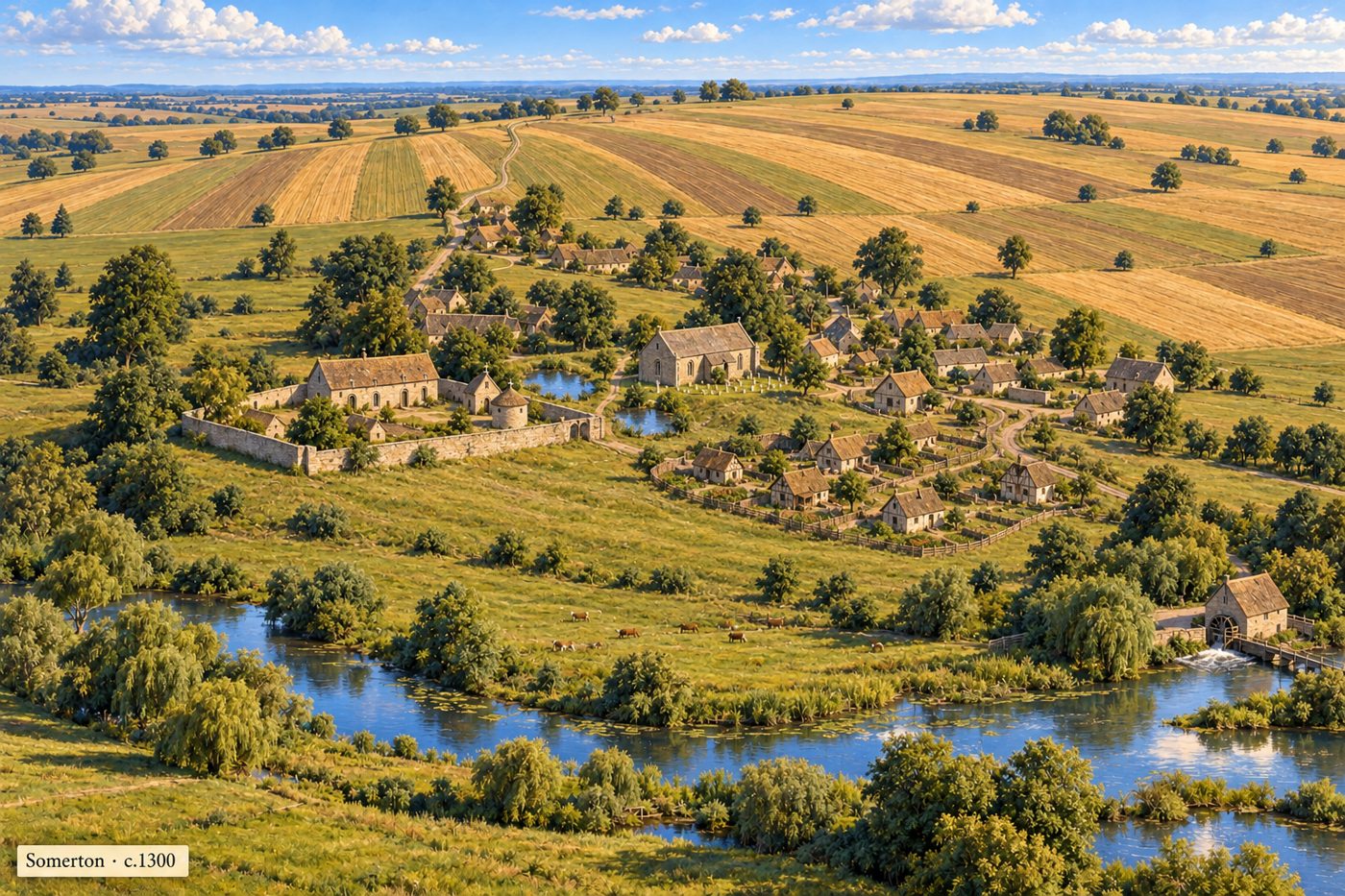
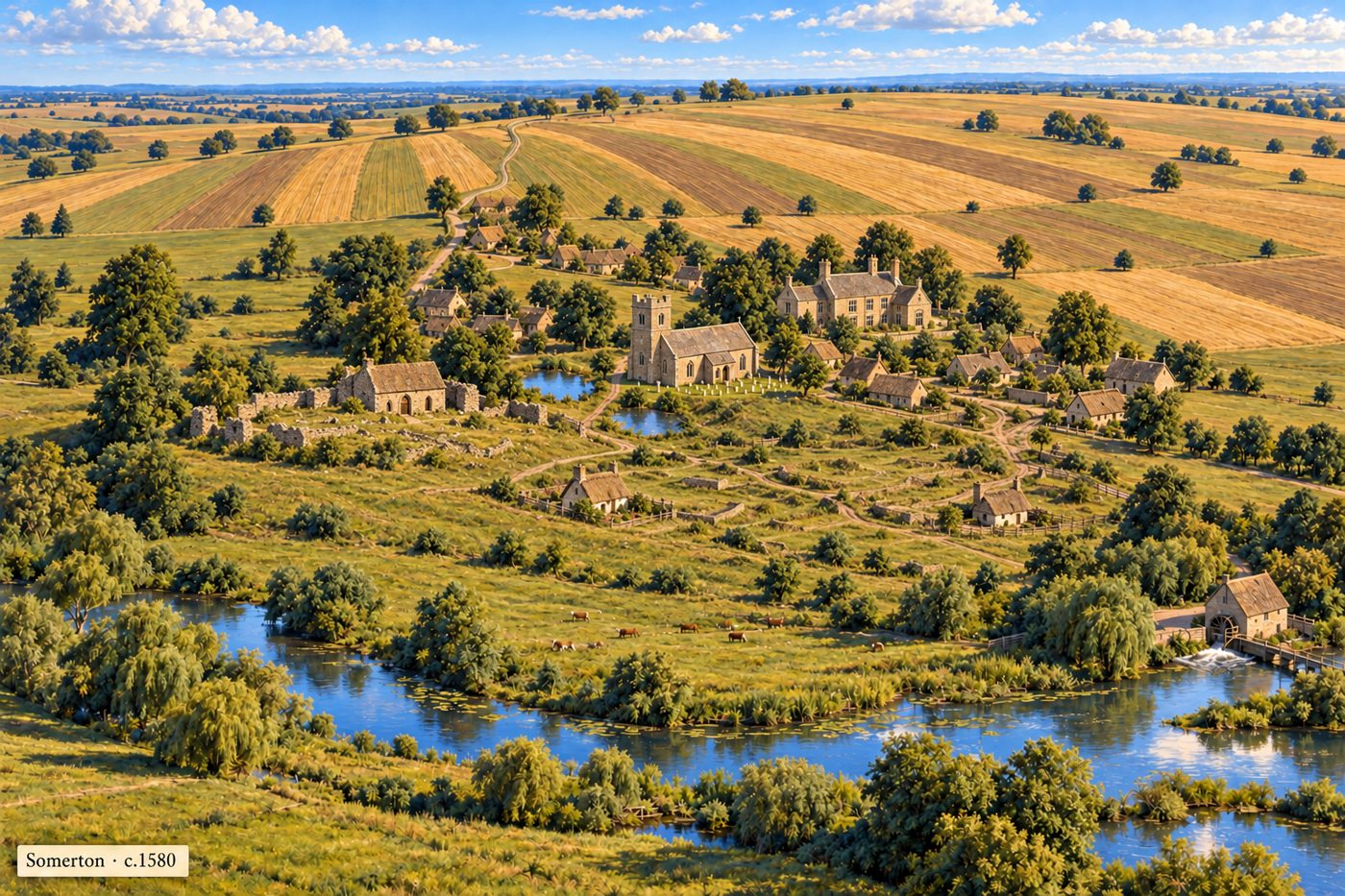
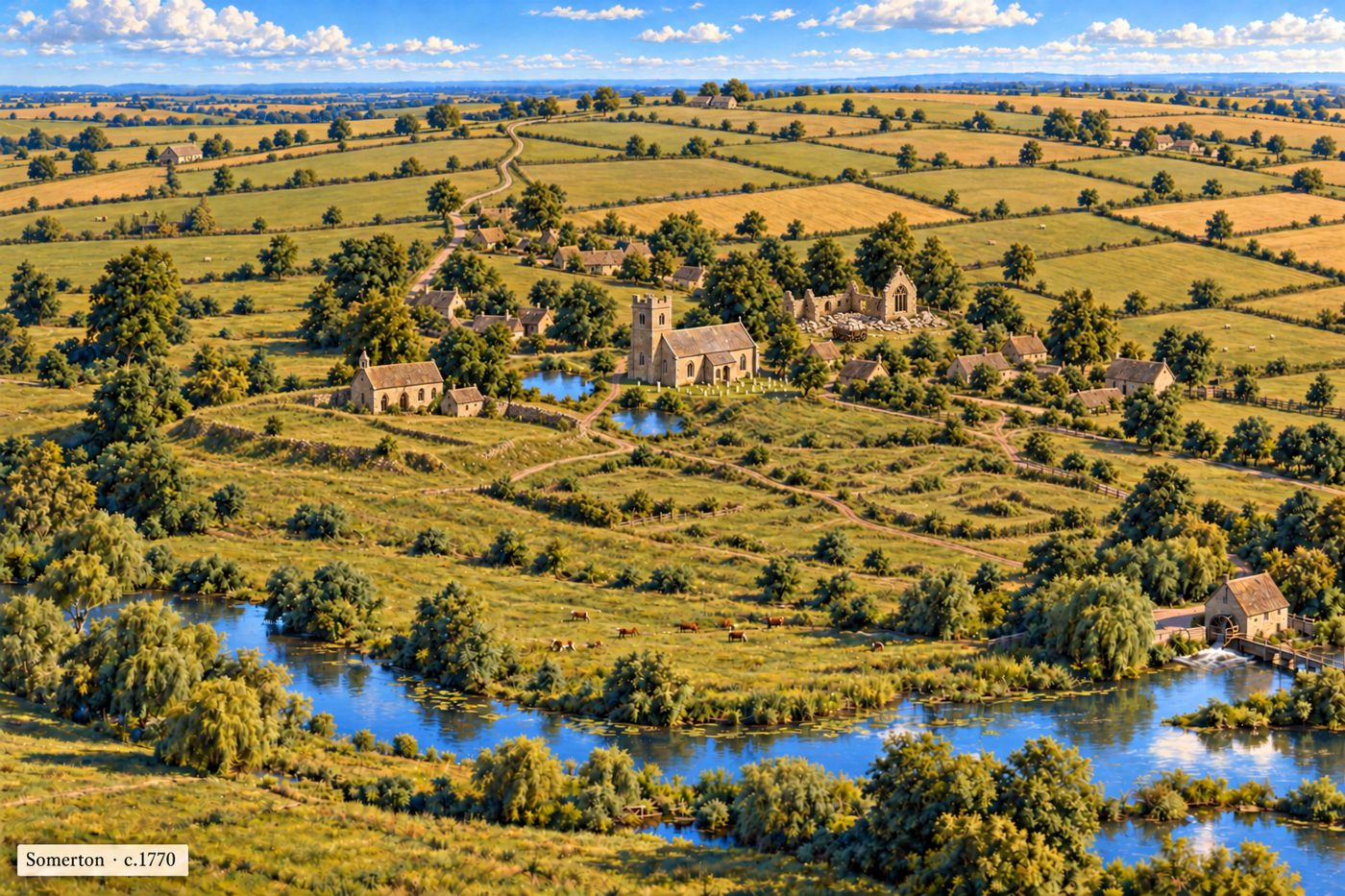
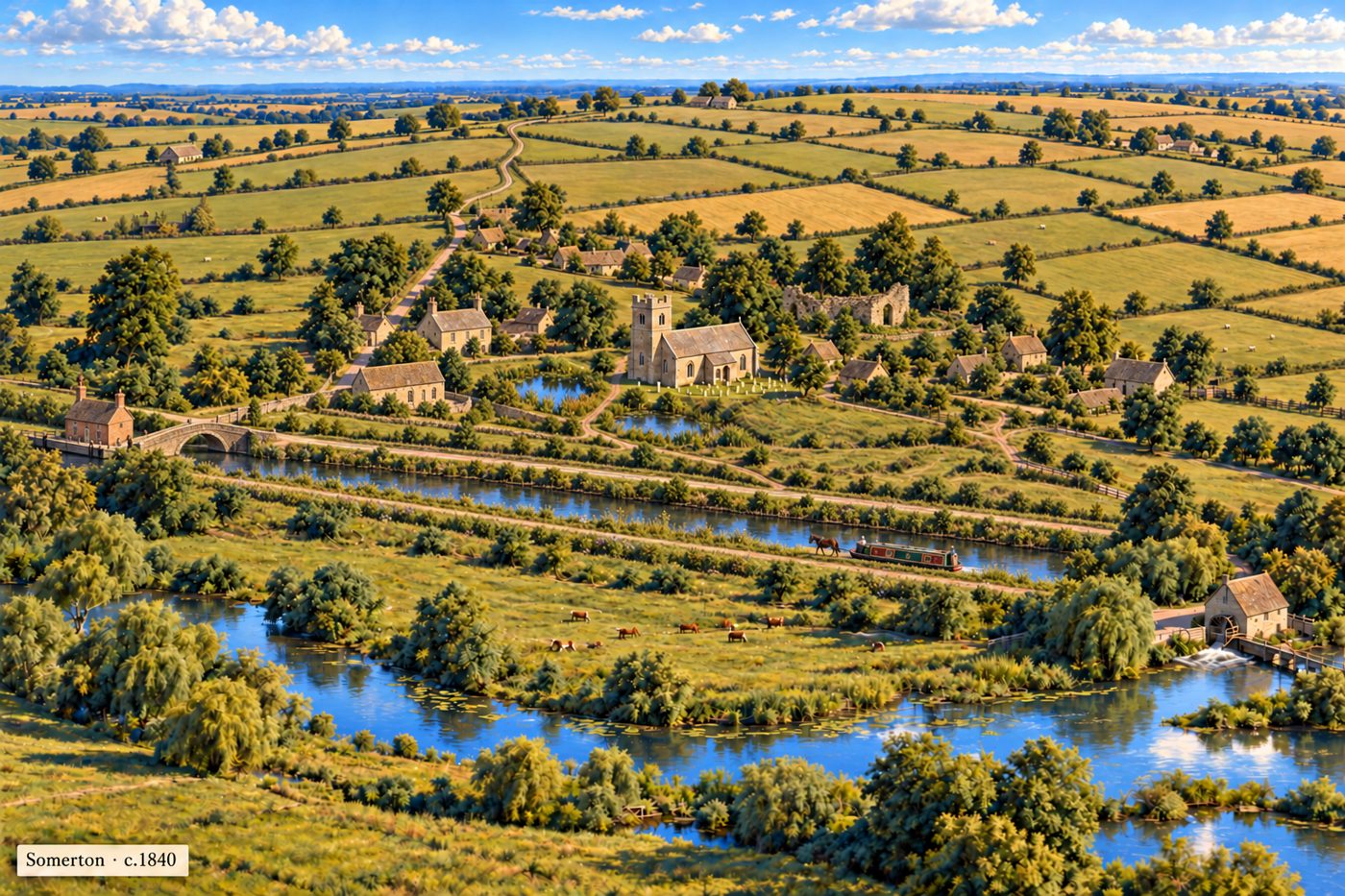
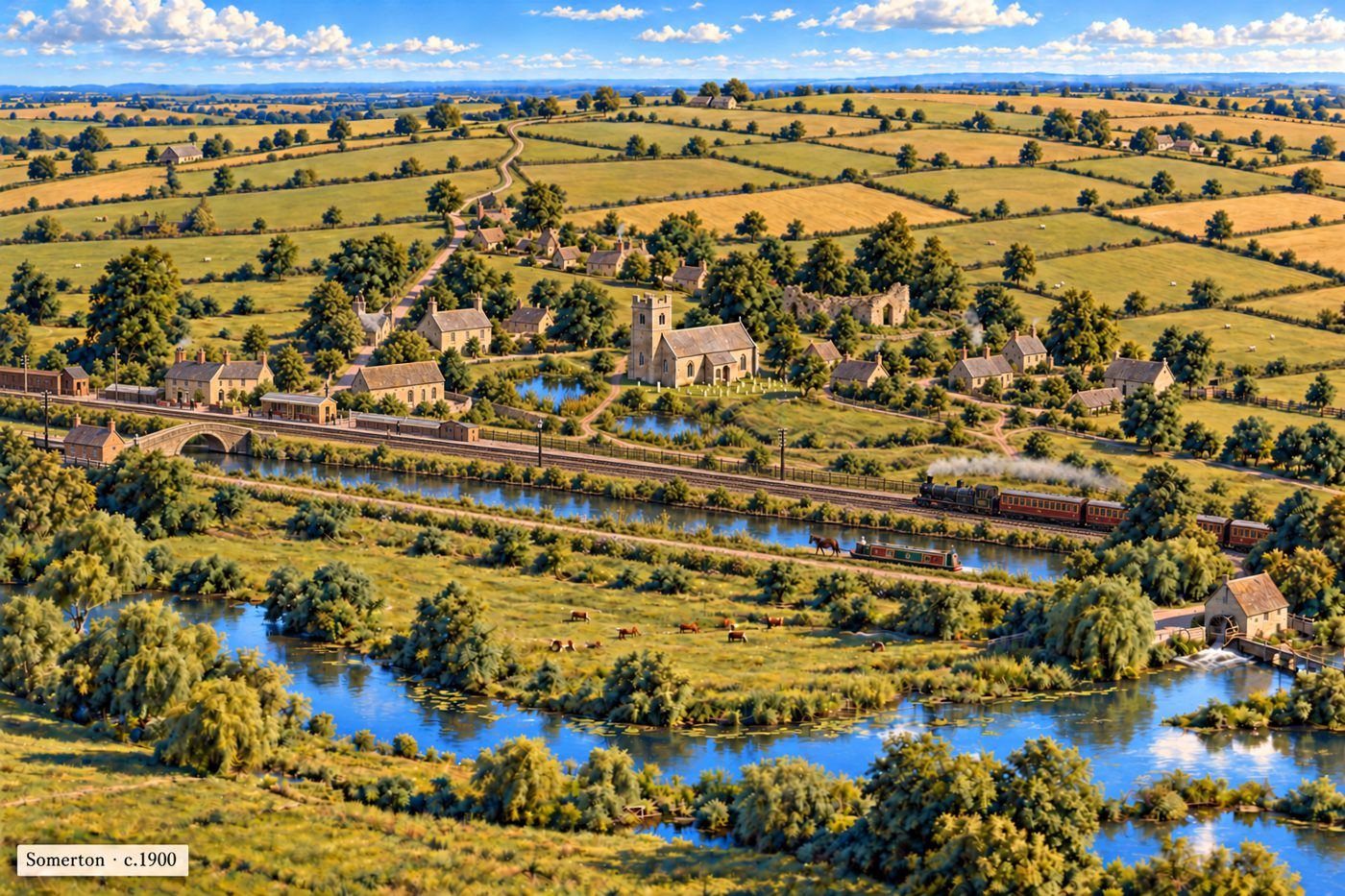
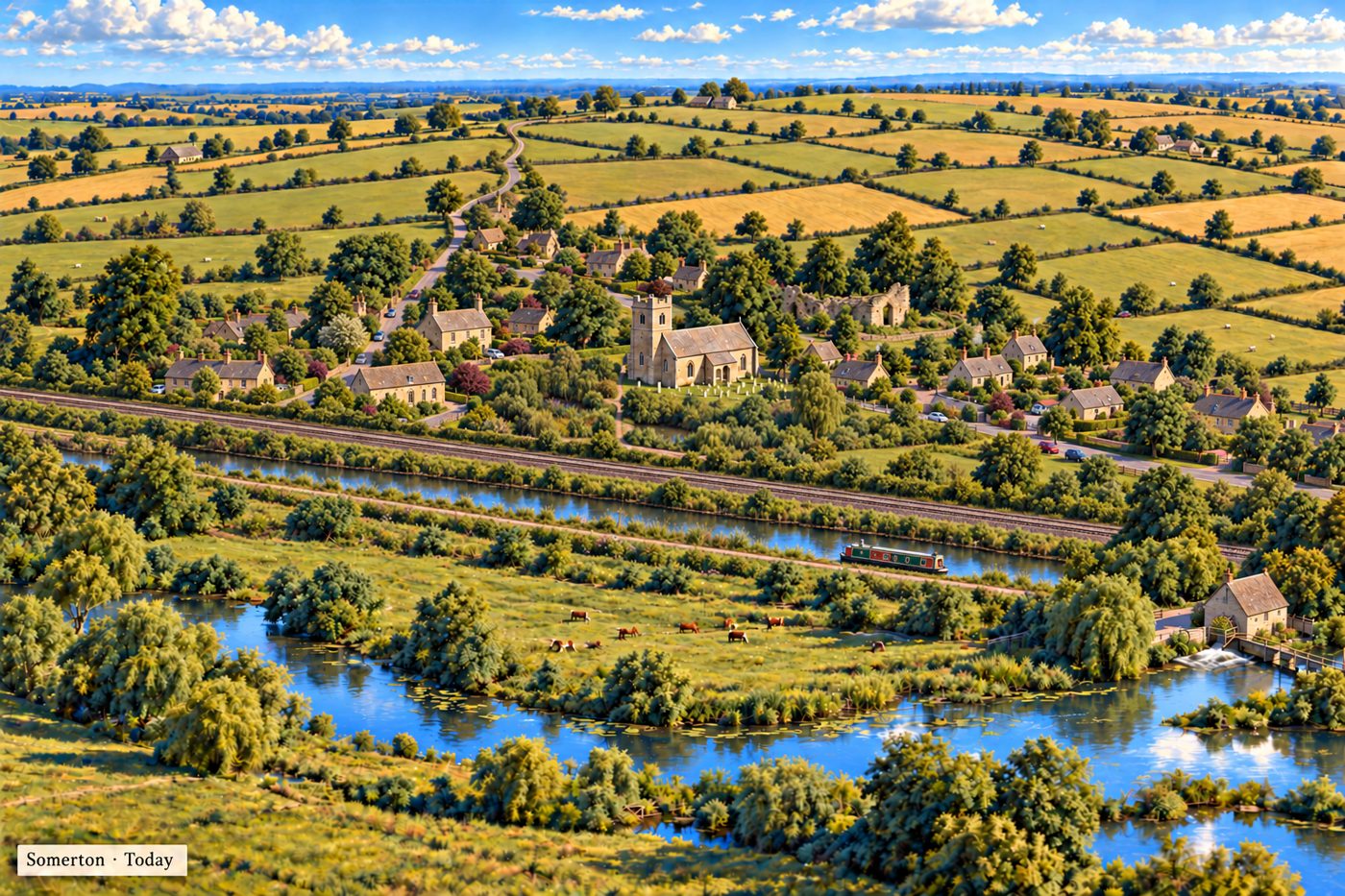
Artist's impressions created by AI from information provided by Della Paviour. They show what the village may have looked like, not exact plans: positions are approximate and many buildings are imagined.

This outline of the village’s history is intended to provide a framework for articles on specific aspects of the village’s life over the centuries. (The chronology that follows is largely based on the Victoria County History where not otherwise specified).
The Norman Period
After his victory at the Battle of Hastings in 1066 the new King William gave most of the lordship of Somerton to his half-brother, the turbulent Bishop Odo of Bayeux, who features in the Bayeux tapestry (which Odo may indeed have commissioned).
In 1086 in the Domesday Book he is recorded as sharing Somerton with Miles Crispin, the son-in-law of Robert d’ Oilly, the Constable of Oxford Castle, but the under-tenant of the whole lordship was Wadard, a close associate of Odo (who also appears in the Bayeux tapestry) .
Though nothing now remains of the medieval castle at Somerton, and its origin is unknown, it seems reasonable to speculate that it may go back at least to the early days after the Conquest. If so, it may have been little more than a stockade. It would have commanded the track leading across the river to North Aston and Deddington where Odo had one of his many residences.
By contrast the original church building on the current site is believed to have been erected within eight years of the Conquest, but the only part of that structure which remains is the blocked-up Norman door in the south wall.
The date of the preaching cross on the north side of the church is also obscure, but it is clearly medieval. Such crosses often go back to Saxon times and were frequently built on pagan sites.
After Odo’s disgraceand banishment back to his bishopric in 1087,and Miles Crispin’s death, Somerton was granted to the Arsic family and became part of the Barony of Cogges near modern Witney.
Read more: The Norman Period · Archaeology & Castle Yard
The Arsic Legacy
Throughout the 12th century the lordship of Somerton stayed in the Arsic family. They were wealthy local landholders and may have been responsible for the major building work on the church at this time. The lower part of the nave probably dates from the 12th Century, and possibly also some of the North aisle.
Read more: The Arsic Legacy
The Lordship Divided
In 1230 Robert Arsic died leaving his estates to his two daughters Joan & Alexandra and from then on the lordship of Somerton remained divided until the early sixteenth century. Joan & her husband soon sold their half to Walter de Grey, Archbishop of York. His family who were major landholders in Oxfordshire, built the medieval castle in Somerton, described in 1295 as having a court with dovecote, fishponds, cartilages (ie surrounding land) & gardens. It is commonly supposed that the present Old School House and old schoolroom stand on the site. The remains of the fishponds can still be seen.
The de Greys and their descendants held their share of the manor until 1485. It reverted to the Crown in 1485 when Francis Lord Lovel was attainted (outlawed). It remained with the Crown till 1512.
After the division of the lordship in 1230 Alexandra’s share passed through marriage to the Gardinis family and then to their relatives, the Giffards. The Giffards seem never to have lived here having preferred their estates in Twyford.
The church saw much development during this period. The chancel probably dates from the late 13th Century. On the south side of the nave there are two 14th Century arches showing that there may have been a longer, south aisle before the Fermor Chapel was built. The bell tower was also probably built in the 14th Century. On the outside of its north wall is a finely carved holy rood probably made at the same time as the tower was built.
The connection between the manor and the church was particularly close in the fourteenth century when two members of the de Gardinis family were rectors for many years. Richard de Gardinis was rector from 1316 to 1349 and probably built a lady chapel and chantry. There is no trace of this now - perhaps it was in the south aisle [and later replaced by the Fermor Chapel]. William de Gardinis who became rector by 1377 and remained till 1392 was more controversial He was alleged to have committed robbery with violence!
John Aston, a relation of the Giffards by marriage also had land at Twyford and in 1438 he exchanged these for the Giffard estates in Somerton. John Aston apparently lived at Troy Farm (then called Somertons) He died in 1459 when he left 100 shillings in his will for repairs to Somerton church.
Read more: The Lordship Divided
The Fermors Reunite the Lordship
John Aston’s son William Aston inherited, but in 1504, shortly before his death, his share was acquired by William Fermor.
Eight years later, in 1512, the Crown granted the de Greys share also to William Fermor who thus reunited the manor. William proceeded to build a fine Manor House, some remains of which can be seen behind Fermor House, to the east of the Heyford Road.
William was the second son of Thomas Fermor, a wealthy merchant from Witney. William held several positions of authority. In 1509 he was coroner and attorney in the King’s Bench Greenwich; he was a JP both for Oxfordshire and the City of Oxford; he was one of the Commissioners for the Ploughley Hundred , the subdivision of Oxfordshire taking in the north-east corner of the country including modern day Bicester)and served as High Sheriff for Oxfordshire in 1533 & 1543. He held onto these positions despite the fact that he was a staunch Roman Catholic. One local historian put it that “Mr Fermor showed no marked opposition to the King’s measures” when Henry VIII broke from Rome - unlike his older brother Sir Richard Fermor at Easton Neston in Northamptonshire, who being “a very zealous Romanist, fell under the King’s heavy displeasure” for supporting his imprisoned confessor and had all his estate confiscated. (Fortunately for the family, it was returned shortly before his death). The Fermors of Somerton by contrast managed to keep their heads down but did not disguise their faith.
Interestingly William Fermor appointed as Rector one Robert King, a distinguished conservative reformer who opposed those who “want to pull down the images of saints and who denied that the Virgin and Saints are mediators”.
William Fermor died in 1552, having been married four times but with no issue. He was buried according to his will “under the new arch, between the aisle of the south side and the choir wherein I used to kneel”…described as “a great raised monument of gray marble - thereon ye picture of a man and a woman in brass.”

This was the first monument in what became the Fermor family mausoleum. The Fermor Chapel has a separate entrance to the south and it is interesting to speculate that William Fermor may have had it built so that he could quietly continue the old rites in a separate part of the church.
His heir was Thomas, the younger son of Richard of Easton Neston, who lived quietly at Somerton for 28 years and quietly resisted the changes of the Reformation period. There is evidence to suggest that there was still a medieval chapel in the castle yard at this time, which was used by Thomas and his recusant followers for Catholic services during Mary’s reign. When he died in 1580 he endowed a free school at Somerton for boys to be instructed in “virtue and learning”. The castle yard chapel was converted into a school building. (The schoolmaster’s house was built about 1750).
Thomas’s fine tomb in the chapel is well documented. Richard and Gabriel Roiley of Burton were to be paid the “full somme of Forty poundes of lawful mony of England”. Under the contract the creature at his feet is supposed to be a lion but is normally described as a dog. ( link to full description of church -The Printed Guide)
His young son Richard came of age in 1596 and bought Tusmore Manor which was to become the principal residence of the Fermors. Somerton, however, remained in the ownership of the family, and the manor house was still occupied by members of the family in 1665. The staunch Roman Catholic tradition of the family continued but Richard and his heirs continued be buried in the Fermor Chapel.
Early in the seventeenth century the Fermors appointed another distinguished cleric to be the Rector of Somerton. William Juxon subsequently became President of St John’s College in Oxford (when he continued to come to Somerton during the vacations), and then Bishop of London. As such he prayed with Charles I on the scaffold before the latter’s execution. (link to picture of execution). After the Restoration of the monarchy in 1660 he was Archbishop of Canterbury for the last years of his life. Juxon was of the ‘high church’ persuasion and would have been happy to accept the Fermors’ continued role in the church locally. By the eighteenth century however more and more of the rectors were non-resident and the church fell into decline.
Henry head of the Fermor family in Tusmore during the Civil War kept a prudent neutrality during the hostilities, but in the Fermor Chapel there is a floor slab to Colonel Thomas Morgan, killed at the battle of Newbury in 1643. He was husband of Jane Fermor, Henry’s aunt.
Cecily moreover the widow of John Fermor, Henry’s eldest son who had died in 1625, held the lands at Somerton “in dower” after her first husband’s death and had then married Lord Arundel of Wardour, the head of another leading catholic family. He too rallied to the support of the King and in 1646 all his estates, including his wife’s lands at Somerton were sequestered, but the family managed to buy them back in 1653 for £1,609 15s 10d.
At their greatest extent the Fermor lands stretched from North Aston in the west to Godington in the east taking in not only all of Somerton, but also some or all Fritwell, Stoke Lyne, Hardwick, Tusmore , Souldern, Croughton and Cottisford on the way.
Throughout their estates the Fermors gave quiet protection to ‘recusants’ (those who refused to attend the Protestant services). In Somerton therefore there remained a significant number of Roman Catholics.Replying to a questionnaire from the Bishop in 1738 the Rector wrote
“Our Parish has always been remarkable for a great many Papists, which I suppose proceeds from most of the Inhabitants being Tennants to Mr. Fermour a Roman Cathk. gentlm. who lives at Tusmore about three miles from us ; I am informed that formerly near half ye Families in ye Parrish were Papists, but they are considerably diminished of late years, there being now 148 Church of England men, and 47 Papists, nineteen of whom are youn’g Children, Servants and Boarders.”
Read more: The Fermor Family · Catholicism in Somerton
Economic Development
In 1512 shortly after his arrival in Somerton William Fermor had attempted to enclose some of the open-fields but this was checked, and while Fermors still lived at Somerton there were no further efforts to enclose the fields but in 1765 another William Fermor gained an Act of parliament to enclose the open fields. This was a fairly simple matter for, except for the glebe(ie church) land, he owned the whole parish .
Somerton was a small but comparatively prosperous village for much of its history. In the 1780s the quiet life of Somerton must have been greatly affected by the construction of the Oxford Canal along the Cherwell Valley (link to article on Canal to follow soon) This must also have been profitable for the Fermors. For some years it was the main artery between London and the Midlands until the Grand Union Canal was built.
Even more traffic was taken from it by the construction of the railway in Victorian times. This must have had an enormous impact. A village which had hitherto been relatively isolated even had its own railway station. The railway station and signal box (both now gone) feature prominently in the Cotswold Club film about Somerton’s Village Produce Association in the Second World War.
The speed of change increased through the twentieth century. Farming remained the main employment but fewer and fewer labourers were needed. The tied farm labourers’ cottages were sold off or rented out to RAF or US service personnel from the Upper Heyford base (link to article on base to follow soon). Few families stayed in the village for more than one or two generations. Local traditions started to die out. ( article on May Day)
William Barnes of Great Duryard in Devon bought the patronage of the parish of Somerton and with it the advowson (the right to nominate the Rector) and in 1875 nominated his son George Edward Barnes who was the Rector between 1875 and 1923. He was no absentee. He lived in considerable style in what is now the Old Rectory and was dedicated to the life of the parish (link to article about the Barnes family to follow soon). Thus was ushered in the last great period of restoration in the church. He introduced many changes to the church installing, probably at his own or his father’s expense, most of the pews in the nave and the magnificently carved pews in the chancel. He commemorated his father in the remarkable window by Christopher Whall.
Read more: Economic Life · Open Fields & Enclosure · The Railway
The Fate of the Manor
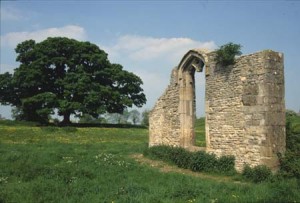
William, the last of the direct male line of the Fermors, sold Somerton to the Earl of Jersey in 1815 for £90,000. By then the Manor House in Somerton was a ruin. It is said that much of the stone was taken for building in the Fermors home at Tusmore [? Photo?] but useful building materials probably found their way into other houses in the village . The Jerseys in turn sold the estate (The Sale of Somerton) in 1919 in several different lots.
The largest part of the Jersey lands in Somerton were sold to Thomas Edwin Emberlin who became lord of the manor. The Emberlins later built themselves a new Manor House to the west of the Heyford road. In her will Miss Sybil Emberlin, the last of the family, left half the proceeds of the sale of this house to the church when she died in 2006. This made possible the major programme to restore the church, conserve its monuments and fit it out to become again a major focus of village life - a programme of which this website and historical project is a minor part.
This article is heavily based on the articles to which it refers and on the chapter on Somerton from the Victoria County History. This can be accessed at http://www.british-history.ac.uk/report.aspx?compid=63749&strquery=Somerton.”
Read more: The Fate of the Manor
New Research, 2026
Added October 2026. Each item below has been checked against the source named with it. Where only a transcript or a later account has been seen, that is said.
Three against two
On 20 August 1860 a single-wicket match was played at Somerton: T. E. Berridge, J. Allabarton and J. A. Pratt against R. J. Berridge and B. Allabarton. Three against two. On 30 July 1866 Mr R. J. Berridge's side of four played Mr W. Hore's side of four. Both games were reported in the Bicester Herald. Who won is still to be found. Small sides like these were a game of their own and are not evidence of a village eleven.
By the 1880s the village had a proper club. In August 1884 Deddington Cricket Club came to Somerton and beat Somerton Cricket Club on its home ground. The match was reported in the Banbury Guardian of 21 August 1884; we have seen the index entry but not yet the report itself, so the teams and scores are still to be found.
From the court reports
On 23 December 1855 a ewe belonging to Isaac Berridge of Somerton was stolen. Edward Smith and Henry Bird of Souldern were sent to Bicester gaol, and at the Oxfordshire sessions on 31 December Smith was given four years' penal servitude.
Edward Warman of Fritwell ran a travelling dancing booth and could not, or would not, keep his horses off the road. In 1867 they were found grazing on the verge of the road from Fritwell to Somerton. In May 1870 the magistrates at Bicester heard that his horse had been straying on the highway at Somerton on 17 May. Mr Godwin of Troy Farm proved the offence. Warman did not turn up. It was his fifth conviction, and he was fined 5s with costs. Superintendent Moulden told the bench that the police had impounded the horse "times out of number". (Another newspaper places the same offence between Fritwell and Middleton.)
In October 1891 Henry Hodson, a 20-year-old boatman, was sent to prison for 21 days by the Bicester magistrates for beating John Brown, aged six, who was travelling with him on the canal. The worst of it happened while the boat was at Somerton. The boy's brother Thomas gave evidence, and Mr Hope Kyd prosecuted for the National Society for the Prevention of Cruelty to Children, which had been founded only two years before. The family were canal travellers, not Somerton people.
Sources: CricketHistory single-wicket checklist, 1860 and 1866, citing the Bicester Herald, 24 August 1860 and 10 August 1866; Institutional History Society, "Edward Smith: The Grieving Thief", citing the Bicester Advertiser, 29 December 1855; Keith Chandler, transcribed newspaper reports on Edward Warman (Bicester Herald, June 1870; Jackson's Oxford Journal, 4 June 1870 and 31 August 1867); transcribed report of Bicester Petty Sessions, 2 October 1891. The original newspapers have not yet been re-checked. The 1884 match: index to the Deddington Scrapbooks, vol. 2 (compiled by George Coggins, Bodleian G.A. Oxon 4° 786), Deddington History, citing the Banbury Guardian, 21 August 1884, p. 8.
The Varsity point-to-point
In March 1928 the Oxford University point-to-point steeplechases were run at Somerton. The Oxford Journal Illustrated of 14 March (page 1) printed three photographs: two riders falling at the first jump in the Bullingdon Club's President's Cup; Mr R. Thackeray's Billy Easy, winner of the Faber Cup nomination race; and Mr G. Aspillaga coming to grief on Donovan in the 'Varsity Grind, with Mr P. L. Kindersley on Jock II, who went on to win.
Exactly which fields the course used is not recorded.
Sources: Oxfordshire History Centre, Oxford Journal Illustrated photograph index 1912-1928.
Somerton's Methodists
Not everyone in Somerton went to St James's. Two nonconformists were reported in 1834, and in 1840 a house was licensed for Wesleyan Methodist meetings. Through the later nineteenth century a few Methodists kept going, though most were said to go to church as well. In the end they met in a cottage that served as a chapel on the Brackley Wesleyan circuit. The 1910 valuation lists it among the cottages at the Paddock, and the valuation map shows it at the end of that row, a little south of the old post office. It closed around 1914 and was pulled down in 1915.
A reading room and a bowling green
The same 1910 survey lists two things we have not found mentioned anywhere else: a reading room and a bowling green, both on the Earl of Jersey's land.
Sources: Victoria County History, Oxfordshire vol. 6, Somerton; 1910 valuation survey, Somerton, Oxfordshire History Centre DV/X/73, seen through Heritage Search.
A Victorian visitor's view
Some time around 1890 William Wing wrote about the River Cherwell for The English Illustrated Magazine, following it from its source in Northamptonshire down to Oxford. He liked Somerton. Seen from the railway, he wrote, "the old church, parsonage, and houses around form a delightful picture", and with the Earl of Jersey as lord of the manor and chief landowner the village had "a less forsaken and better cared-for appearance" than many others along the river.
He picks out the Fermor chapel and its oak screen, Bishop Juxon's arms carved in oak, the carved Last Supper, the old village cross, and the last piece of the Fermor mansion: "a ruined piece of wall with Gothic window" looking across the valley to North Aston. He also repeats the story that Arabella Fermor, the heroine of Pope's The Rape of the Lock, belonged to this same Somerton family. All of these can still be seen today, apart from Arabella.
Sources: William Wing, "The River Cherwell", The English Illustrated Magazine, vol. 8, p. 484 onwards; transcription on The Victorian Web. The Victorian Web dates the volume 1880 to 1881, but the magazine did not begin until 1883, so we think it is from about 1890 to 1891.
A petition to the House of Lords, 1837
On 6 March 1837 a petition from the "Inhabitants of Somerton" was presented to the House of Lords. It asked the Lords to "resist all attempts that may be made to interfere with its rights, independence, and privileges". Petitions with the same wording came in the same day from Aynho, Newbottle and Croughton, from Souldern, from Deddington, and from Sandford, Great Tew and the Wortons. The report gives no names or numbers, so we do not know who in Somerton signed it, or how many.
Sources: London Courier and Evening Gazette, 7 March 1837, p.3, seen in the Deddington History transcription, 1830 to 1837. The original newspaper page has not been seen.
Isaac Berridge, landowner
Isaac Berridge of Somerton had interests well beyond the village. In 1847 he bought half of the manor of Westcott Barton, a few miles west across the Cherwell valley, and sold it ten years later to the Rev. Jenner Marshall. He is very probably the Isaac Berridge listed in 1852 as a Somerton farmer, surveyor and estate agent, whose ewe was stolen in 1855. Marshall's history of Westcott Barton notes that the old manor dovecote "was demolished when the alterations took place while Mr. Berridge was owner".
Sources: Rev. Jenner Marshall, Memorials of Westcott Barton, in the County of Oxford (1870), p.49, scan of the book.
Grass that turned to stone, 1677
Robert Plot, the first keeper of the Ashmolean Museum, came round Oxfordshire in the 1670s collecting curiosities for his Natural History of Oxford-shire. Somerton, which he spells "Sommerton", gave him several.
One was a little waterfall. A stream here, he wrote, "makes a small Cascade, or fall of water about seven foot high". Had it been in a gentleman's garden it might have been made something of, but it ran beside the highway, so to Plot it was good only for experiments. The water was so stony that living blades of grass, not half a year old, were "all covered with stone, and hang down the bank like so many Isicles".
He also found fossils shaped like small human ears, which he named Otites. The most he saw anywhere were "in a bank near a spring rising at Sommerton Towns end, Eastward from the Church", on Richard Fermor's land.
And then there is the odd one. Plot had heard that a rector of Wendlebury, dug up nearly forty years after his burial, still had flesh as red as raw beef. He wondered whether the stony water was the reason, and suggested someone should test whether flesh decayed more slowly in it, "about Sommerton or North Aston", where it would be easy. As far as we know, nobody did.
Where the cascade was is not certain. The springs still run off the hill into the Cherwell, and Lewis's Topographical Dictionary was still describing a petrifying spring with a small cascade in 1848.
Sources: Robert Plot, The Natural History of Oxford-shire (Oxford, 1677), ch. II §22 p.32, ch. V §150 p.130, ch. VIII p.213, read in the Early English Books Online keyed text; Samuel Lewis, A Topographical Dictionary of England (1848), transcription.
Four hundred years of arguing about bridges
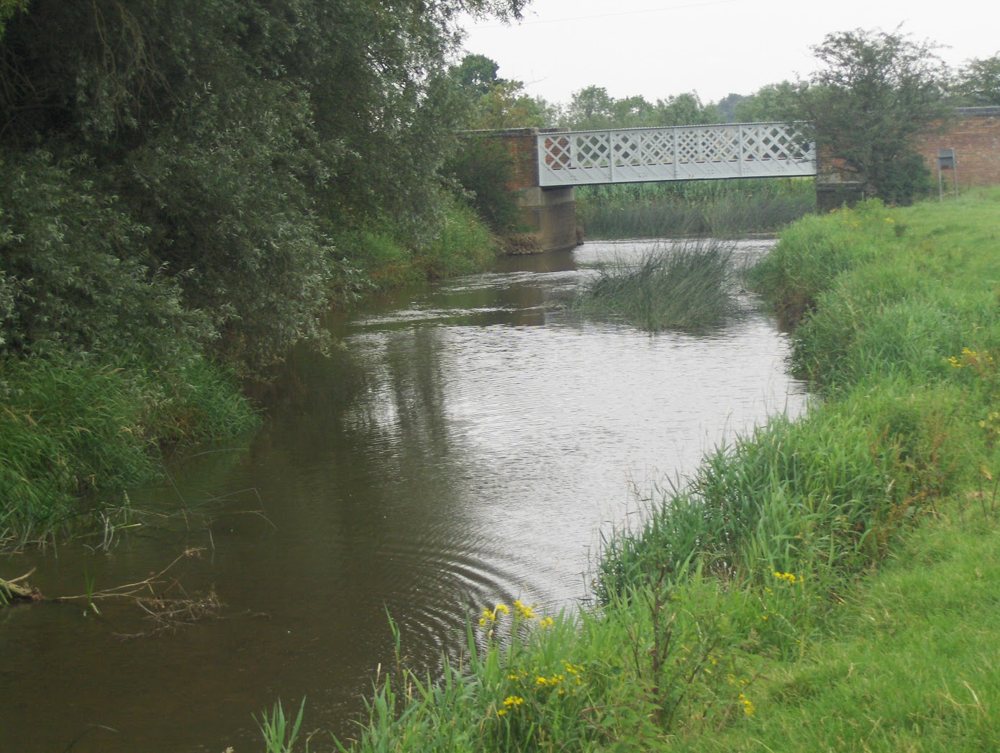
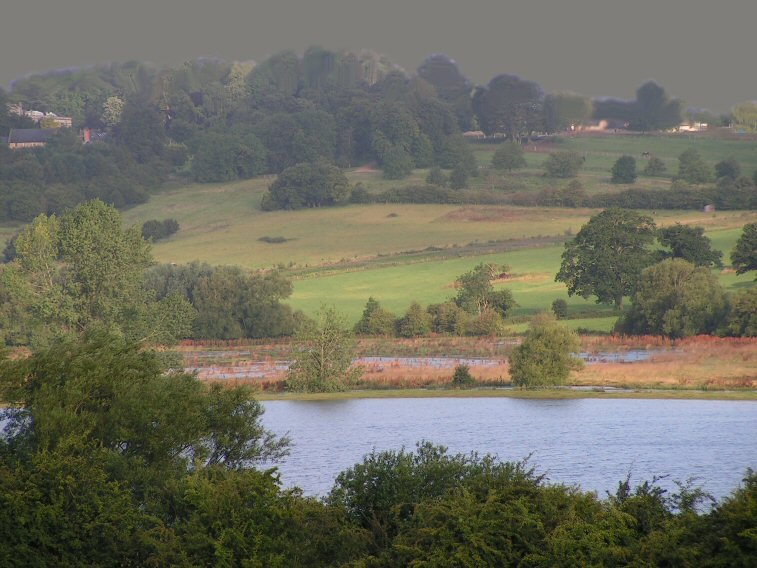
The road from Somerton to North Aston crosses the Cherwell meadows on a causeway with several bridges, and for centuries the two villages could not agree who should mend them.
The first we hear of it is "Gambon brugge", the bridge over the western arm of the river by the mill, named in the thirteenth century. The quarrel over the causeway ran into the 1600s. In 1624 the two lords of the manor finally split it: North Aston's lord took the bridge over the Old Cherwell and the next one towards Somerton, and Somerton's lord took the rest of the bridges and the causeway.
When the canal was dug in 1787 the Oxford Canal Company seems to have rebuilt the causeway. The county took over the mill bridge in 1868, and the bridge between the mill and Somerton in 1887, "after it had collapsed".
The water itself caused rows too. In 1402 New College claimed £20 in losses and £40 in damages, blaming the flooding of its meadow at Heyford on the stream that fed its mill being turned towards Somerton.
Sources: Victoria County History of Oxfordshire, vol. 6, Somerton and Upper Heyford; vol. 11, North Aston. Later accounts; the original agreements have not been seen.
How many of us were there?
Somerton was one of the biggest and richest villages in Ploughley hundred until the middle of the nineteenth century. The head-counts, such as they are, bear that out.
- 1377: 108 adults paid the poll tax.
- 1524: 39 people were taxed, at least 11 of them wage-earners, which is an early sign of men who worked for others rather than holding land.
- 1573: 19 tenants and two freeholders who lived elsewhere, holding about 38 virgates between them.
- 1660s: at least ten substantial houses besides the manor house.
- 1676: 242 adults.
- 1811: 55 houses.
- 1851: 78 houses, the most there have ever been. By 1901 there were 64, and still 64 in 1951.
These are not all counting the same thing, so they do not make a neat graph. Taxpayers, adults and houses are three different measures. But the shape is clear enough: a big medieval village, a peak in the 1800s, then a long slow decline through the twentieth century.
Sources: Victoria County History of Oxfordshire, vol. 6 (1959), Somerton. A later account; the tax returns themselves have not been seen.
A pewter measure, 1854
On 1 November 1854 William Fathers, a Somerton mason, lost a pewter measure "and other articles". Catherine Blaby, aged 65, and Emma Blaby, aged 28, both of Somerton, were charged with stealing them. The constable was Thomas Moulden of Middleton Stoney, and John Blaby, a gardener, and Ann Blaby, a servant, both of Fritwell, stood surety for Catherine.
The case came up at the Epiphany Quarter Sessions in January 1855. Catherine was acquitted. Emma was given two months' hard labour.
We do not yet know how the two women were related, or whether they were family to Mahala Blaby, whose story is linked with the terracotta gravestones in the churchyard (see Mahala Blaby & the Terracotta Gravestones). The witnesses' statements survive and would tell us a great deal more.
Sources: Oxfordshire History Centre, Quarter Sessions QS1855/1/L2/78, L2/147, L2/157, L2/158, L3/13 and L4/36 (catalogue entries seen, documents not yet seen); Oxford Chronicle and Reading Gazette, 6 January 1855, p.3, for the verdicts (newspaper search text seen, full page not yet read).