Situated about one and a half miles east of the village is one of only eight turf labyrinths or mazes left in England - and one of the best preserved, thanks to being in a private garden where it has been well maintained. Troy Farm, which holds the maze, was noted even in the 1919 sale particulars as having "a Maze of 480 yards, which has more than a local reputation."
Description
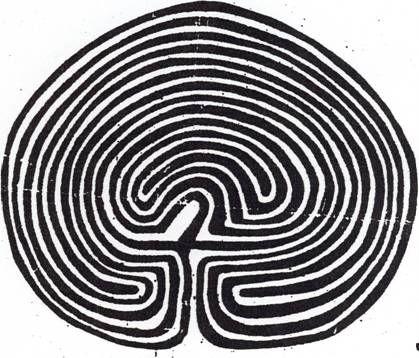
Formed by cutting the ground surface to leave turf ridges and shallow trenches, the maze measures approximately 50 feet by 60 feet and consists of 15 concentric circles. The path is 1 foot wide and winds for a length of about half a mile. It was originally surrounded by a yew hedge which gave it protection. The design has been compared to a pattern of twelfth-century floor tiles in Toussants Abbey, Chalons sur Marne, France.
Other Turf Mazes in England
Commonly called mazes, in the strict sense these are labyrinths, having no path choices or dead ends. The only other known ones still in existence in the UK are: Wing Turf Maze (Wing, Leicestershire); Julian's Bower (Alkborough, Lincolnshire); Saffron Walden Turf Labyrinth (Essex); Hilton Turf Maze (Cambridgeshire); Breamore Maze (Breamore Down, Hampshire); Walls of Troy (near Brandsby, Yorkshire); and St Catherine's Hill (Winchester, Hampshire).
Names and Origins
Turf mazes were often called Troy Town, Walls of Troy or Julian's Bower. The origins of the name Troy are debated. Suggestions include the Celtic "TRO" or "TROYOW" meaning circular or twisting; the Welsh "CAERDROIA" (turf maze) derived from "TROI" meaning to turn; the French "TROIS TOURS" meaning three windings; and the theory that the name comes from a game played by Roman youth described in the Aeneid as "Lusus Troiae" - the Game of Troy - likened to the Cretan labyrinth.
Turf mazes were once common in England, and Shakespeare refers to them in A Midsummer Night's Dream when Titania says: "the quaint mazes in the wanton green / For lack of tread, are undistinguishable." These lines refer to very wet weather making them untreadable, rather than disuse. Many did disappear due to neglect, and Cromwell was responsible for the destruction of others, though there was a revival following the Restoration of the Monarchy.
The Somerton Maze
The present Troy Farm dates from the early 18th century, but there was a 15th-century manor house originally on the site known as "Somertons," belonging to the Aston family. It is probable that the Somerton maze was constructed in the late 16th to early 17th century, and the house renamed to include the maze. Dating turf mazes is extremely difficult without documentary evidence. The Somerton map of 1797 shows only the buildings of Troy Farm, the mapmaker perhaps regarding the maze as of little importance.
W.G. Barnes, son of a former rector of Somerton, writes that "local tradition avers that the maze was cut by villagers out of common land." A previous owner records that "until recent years the children came on May Day to tread the maze" - and the school day memories confirm this. Sheila Stevens recalled that when she worked at Troy later, "Freddie Golder put weedkiller on the Maze instead of fertilizer and all the grass disappeared!" The maze has since been fully restored.
Whatever their purpose or origin, turf mazes are an oddity, a throwback to the past kept alive today by a band of caring people. The cost of their upkeep is great, and visitors - by appointment please - are asked to make a donation.
- Rosemary Arnold - Somerton Turf Maze
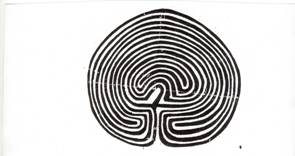
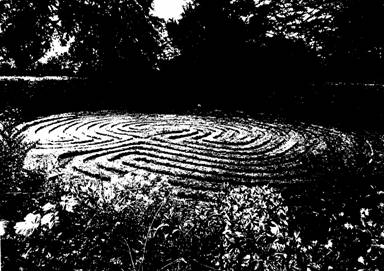
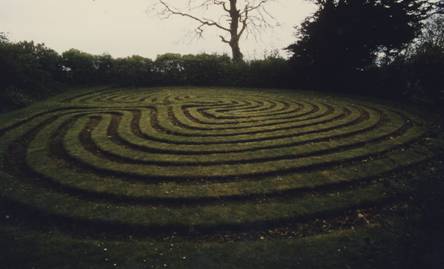
Diagrams of England's Turf Mazes
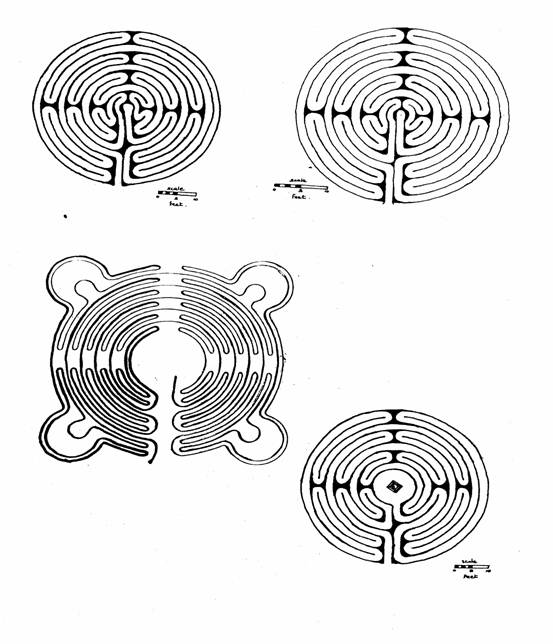
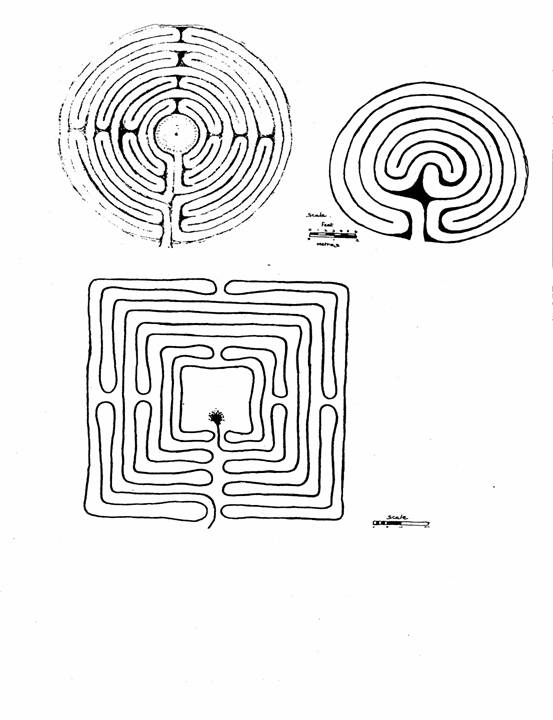
New Research, 2026
Added October 2026. Each item below has been checked against the source named with it.
May Day at the maze
In the 1930s and 40s the schoolchildren's May Day round took them up to Troy Farm in the afternoon. Former pupils remembered that Mrs Hill gave them tea and they were allowed to go round the maze. A girl from the village knew how it should be walked, so it was follow my leader. Their memories are on School Days.
This is the only Somerton custom we have found connected with the maze. Turf mazes elsewhere in England have been linked by writers with games, dances and older beliefs, but we have no evidence of any of these at Somerton.
Source: former pupils' recollections, School Days and The School.
A scheduled monument
In June 2020 Historic England made the maze a scheduled monument, which gives it legal protection. Its description dates the maze to the late fifteenth, sixteenth or early seventeenth century, while saying that an exact date cannot be established. It suggests the maze may have been part of a garden design, perhaps with the circular pond to its south-east. It also notes that the maze has fifteen circuits, where eleven is more usual, and that fewer than eight turf mazes in England are thought to survive in their original places.
Source: Historic England, "Turf Maze at Troy Farm", list entry 1468043, first scheduled 9 June 2020 (read in full).